New research project: Systemic regional designing for long-term, desirable futures
 PhD research Magdalena Grienig (2025-2030): Systemic regional designing for long-term, desirable futures in the Anthropocene
The PhD project of Magdalena Grienig is co-supervised by Sven Stremke and Ilse Voskamp of the Landscape Architecture Chair Group, Wageningen University. This PhD project investigates the theoretical and methodological enhancement of regional designing to develop long-term, desirable futures that are adequate to address the complex and interrelated challenges posed by the Anthropocene.
The immense impact that humans have on the planets interconnected systems in the Anthropocene, means that there is an urgent need for deep transformation processes to address complex challenges, such as climate change and biodiversity loss (Andersson et al., 2024). But how can we imagine and plan sustainable futures when the path forward is uncertain? Long-term future visions are required to imagine pathways towards sustainability and formulate short-term actions (Bai et al., 2016). The development of desirable futures is especially promising according to recent studies (Bai et al., 2016; Bina et al., 2024; Nalau & Cobb, 2022) but their appearance in visioning exercises is currently still quite limited (Nalau & Cobb, 2022).
As desirable futures challenge the status quo and inspire change beyond what is currently thought possible, they possess a high transformative potential (Bina et al., 2024). However, there is little agreement on methodologies and the suitability of current approaches (Nalau & Cobb, 2022). Creative approaches more generally and design-led approaches more specifically were recently identified to hold much potential regarding visioning for desirable, long-term futures (Cork et al., 2023; Juri et al., 2025; Voskamp et al., 2022). Those approaches are especially suited to address wicked problems, such as climate change (Kempenaar, 2020). Regional designing is such a creative, design-led approach, suitable for formulating long-term, systemic future visions (Kempenaar & van den Brink, 2018; Voskamp et al., 2026).
This PhD research project will investigate the potential contribution of regional designing to the development of long-term, desirable futures. Furthermore, it will create a better connection to other relevant fields of research, to create exchange and benefit from proven methods. The research project will identify (1) the current limitations of regional designing in engaging with the development of long-term, desirable futures, (2) examine suitable theoretical concepts from other disciplines that could support regional designing in this endeavour and (3) develop and test targeted advancements in regional designing to improve the analysis of socio-techno-ecological systems and the design of long-term, desirable futures. For the third objective, a research through design approach is employed, involving the Agrieli research project in cooperation with ENSP in Versailles/France as a case study.
About: Magdalena Grienig recently started working as a PhD researcher at the Landscape Architecture chair group of Wageningen University & Research. For her PhD project Magdalena can draw on previous experiences. She worked in the field of spatial energy transition for the Netherlands at Generation Energy as a strategic spatial designer. There, she was involved in the development of several long-term energy visions and scenario studies on the regional and provincial scale. Before that, she developed a special interest in designing landscapes for the Anthropocene, to create synergies between humans, non-humans, infrastructures and the natural sphere. Her background in working with the energy transition and her curiosity for other ways of designing for an uncertain future will feed into her PhD research, taking an integrated, transdisciplinary and design-driven approach to investigating long-term transformation processes for sustainability.
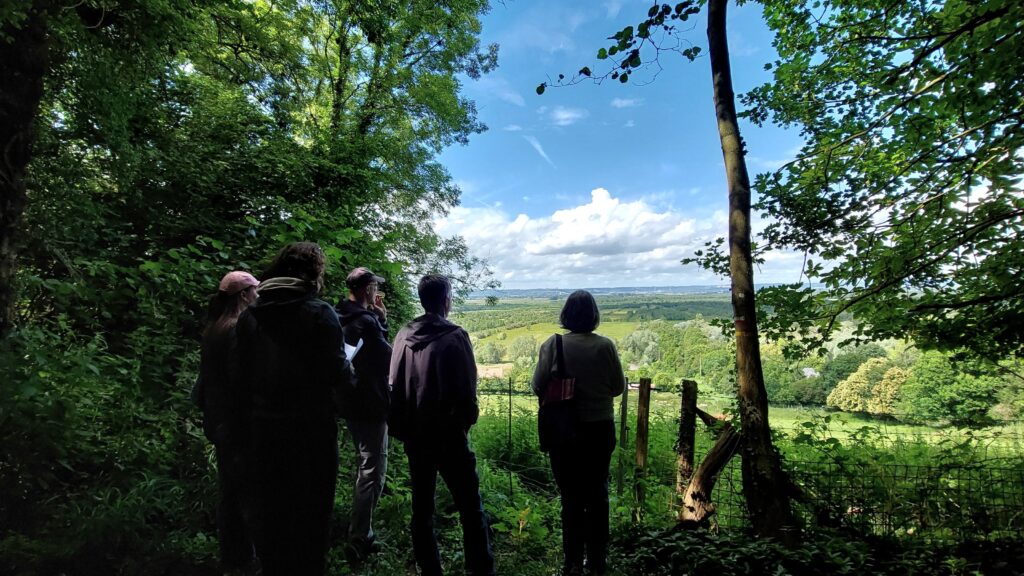
Figure: Looking over the Saine-valley region in France during a field visit for the Agrieli project in cooperation with ENSP (Photo: Roberta Pistoni)
References
-Andersson, J., Lennerfors, T. T., & Fornstedt, H. (2024). Towards a socio-techno-ecological approach to sustainability transitions. Environmental Innovation and Societal Transitions, 51. https://doi.org/10.1016/j.eist.2024.100846
-Bai, X., van der Leeuw, S., O’Brien, K., Berkhout, F., Biermann, F., Brondizio, E. S., Cudennec, C., Dearing, J., Duraiappah, A., Glaser, M., Revkin, A., Steffen, W., & Syvitski, J. (2016). Plausible and desirable futures in the Anthropocene: A new research agenda. Global Environmental Change, 39, 351–362. https://doi.org/10.1016/j.gloenvcha.2015.09.017
-Bina, O., Baptista, M. D., Pereira, M. M., Inch, A., Falanga, R., Alegría, V., Caquimbo-Salazar, S., Duarte, D. H. S., Mercado, G., Valenta, A. T., Vásquez, A., & Verellen, T. (2024). Exploring desired urban futures: the transformative potential of a nature-based approach. Futures, 159. https://doi.org/10.1016/j.futures.2024.103362
-Cork, S., Alexandra, C., Alvarez-Romero, J. G., Bennett, E. M., Berbés-Blázquez, M., Bohensky, E., Bok, B., Costanza, R., Hashimoto, S., Hill, R., Inayatullah, S., Kok, K., Kuiper, J. J., Moglia, M., Pereira, L., Peterson, G., Weeks, R., & Wyborn, C. (2023). Exploring Alternative Futures in the Anthropocene. Annual Review of Environment and Resources, 48(1), 25–54. https://doi.org/10.1146/annurev-environ-112321-095011
-Juri, S., Marais-Potgieter, A., Achieng, T., Gianelli, I., Kabisa, M., Nkgothoe, B., Ojino, J., Tcheton, S., Carpenter-Urquhart, L., & Pereira, L. M. (2025). Transforming towards what? A review of futures-thinking applied in the quest for navigating sustainability transformations. Environmental Research Letters, 20(5). https://doi.org/10.1088/1748-9326/adcbc4
-Kempenaar, A. (2020). The Connection Between Regional Designing and Spatial Planning. In Shaping Regional Futures (pp. 59–69). https://doi.org/10.1007/978-3-030-23573-4_5
-Kempenaar, A., & van den Brink, A. (2018). Regional designing: A strategic design approach in landscape architecture. Design Studies, 54, 80–95. https://doi.org/10.1016/j.destud.2017.10.006
-Nalau, J., & Cobb, G. (2022). The strengths and weaknesses of future visioning approaches for climate change adaptation: A review. Global Environmental Change, 74. https://doi.org/10.1016/j.gloenvcha.2022.102527
-Voskamp, I., Timmermans, W., Roosenschoon, O., Kranendonk, R., van Rooij, S., van Hattum, T., Sterk, M., & Pedroli, B. (2022). Long-Term Visioning for Landscape-Based Spatial Planning—Experiences from Two Regional Cases in The Netherlands. Land, 12(1). https://doi.org/10.3390/land12010038
-Voskamp, I. M., Woolderink, H. A. G., & Timmermans, W. (2026). A landscape-based vision with climate change adaptation underlying urban development: Engaging decision-makers through visioning in the Metropolitan Area Arnhem–Nijmegen. Journal of Water and Climate Change. https://doi.org/10.2166/wcc.2026.250
